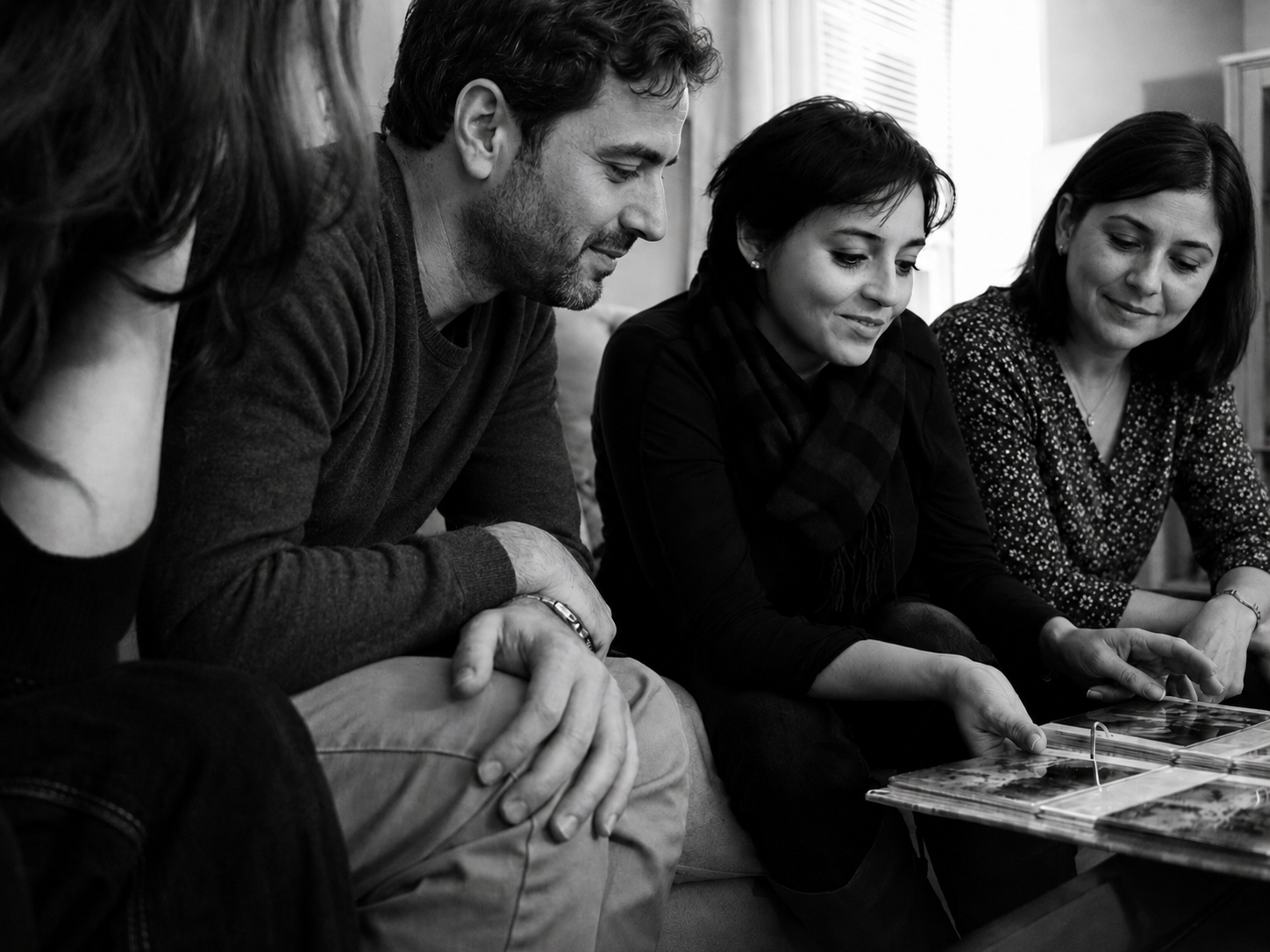
Historical inheritance, transformed into assets of clarity and long-term value
Especially for families, founders, estates, and institutions,
Amy Rookstool turns documented history into usable legacy assets that support stewardship, decision-making, and continuity across generations.

History becomes strategic when
continuity is under pressure.
When wealth changes hands, leadership shifts, property is reinterpreted, or family memory becomes fragmented, history stops being background. It becomes infrastructure.
In those moments, the cost of weak historical handling is not only emotional. Families lose clarity. Institutions lose coherence. Estates lose depth. Public narratives flatten. Meaning becomes easier to dilute, misstate, or inherit without context.
The right historical work helps reduce that drift. It anchors identity before transition, interpretation, transfer, or time place pressure on meaning.
Especially relevant for: succession and inheritance transitions, fragmented family history, estate and property interpretation, founder legacy before change, institutional identity work, and place-based continuity challenges.
This work is designed to produce usable legacy assets.
Not loose notes. Not disconnected records.
Not beautiful language without documentary foundation.
1. Documented Foundation

Evidence-backed historical and lineage research anchored to the record.
2. Coherent Interpretation

Synthesis that connects names, records, places, and patterns into a form people can actually use.
3. Stewardship Value

Deliverables that support decisions related to inheritance, governance, preservation, identity, and public interpretation.
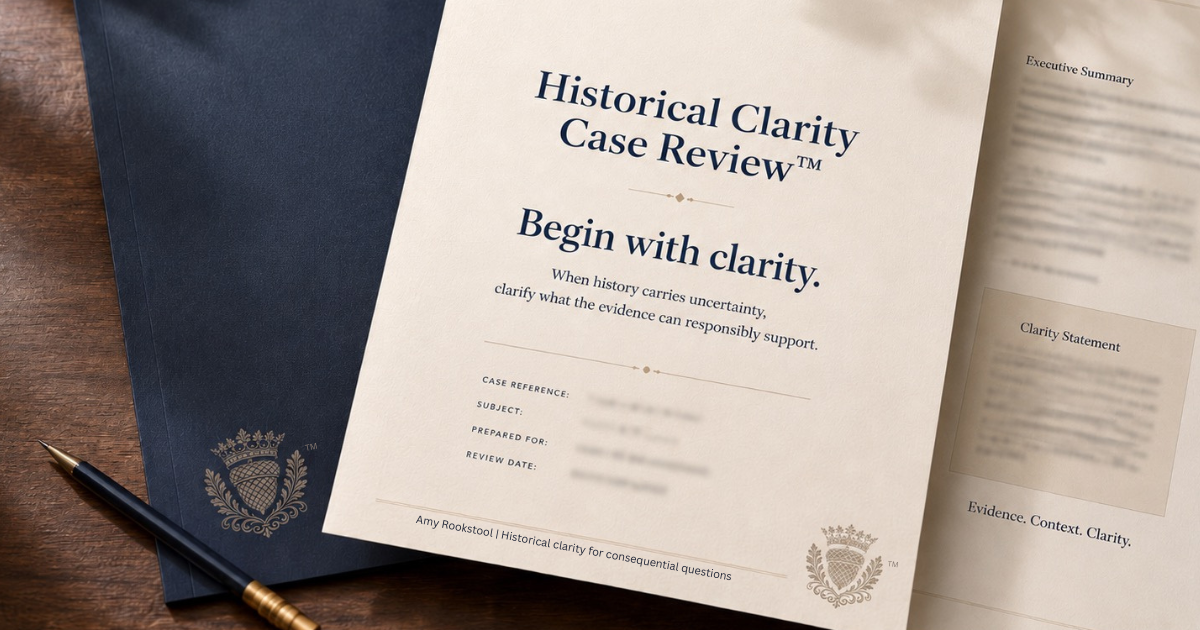
At the center of this work is The Inherited Map Signature Dossier: a premium legacy asset that brings together documented history, interpretive synthesis, and continuity framing in one coherent form.
A different kind of historic advisory
A premium continuity advisory that uses documented history as a strategic asset.
This work helps clients recover, clarify, and organize inheritance that has become fragmented, obscured, or underused—and translate it into a form that can guide real decisions.
Not mass-market genealogy
Not a template ancestry report
Not sentimental heritage storytelling without documentary rigor
Not archival accumulation without interpretive structure
Built on evidence. Refined through interpretation.
Designed to restore coherence.
Amy Rookstool combines archival research, lineage continuity work, and historical synthesis in a form that is rare in the market.
Her work is not only about discovering what happened. It is about clarifying what inheritance means, how continuity is carried, and how documented history can serve living families, leaders, institutions, and places.
Her work is built to withstand scrutiny and restore coherence.
• 559,000+ contributions
• 471,000+ sources attached
• 67,000+ persons created
• 20,000+ memories preserved
* These proof strip numbers are measured by FamilySearch, the largest genealogical database in the world. Additional contributions on other platforms not included in this proof strip.
This pattern reflects more than activity.
It reflects source-dense, evidence-led work grounded in identity clarification, documentary discipline, and continuity-minded preservation.
More than collection. More than narrative.
Many forms of ancestry work stop at collection. Many forms of storytelling begin before the evidence is stable.
Amy’s work follows a different sequence: first anchor the record, then separate identities clearly, then translate historical inheritance into a form that is grounded, meaningful, and usable.
That difference matters most when the stakes are high—when families, estates, institutions, or places need history that can do more than inform. They need history that can hold.
This work is best suited for clients facing meaningful questions of inheritance, identity, continuity, stewardship, or place.

• Families navigating succession, inheritance, or fragmented historical memory
• Founders or legacy-minded leaders preparing for transition or long-range continuity
• Estates and historic properties requiring documented interpretive coherence
• Institutions and place-based communities seeking identity anchored to the record
• Clients who value rigor, discretion, depth, and usable outcomes over speed or volume
This practice is generally not the right fit for casual tree-building, one-off record lookups, or low-context ancestry requests.
Engagement Pathways
Each Engagement is selective and custom-scoped, but the work generally begins in one of three ways.
1. Continuity Brief

A focused starting engagement for one lineage question, identity issue, property history problem, or continuity challenge.
Best for clients who need clarity on a specific matter before determining whether broader work is warranted.
2. The Inherited Map Signature Engagement

The flagship private engagement.
Designed for clients who need documented history, interpretive synthesis, and continuity framing brought together in a premium dossier that can guide stewardship, understanding, and next decisions.
3. Legacy Architecture

A broader strategic engagement for estates, historic properties, institutions, family enterprises, and place-based legacy initiatives.
Best suited to matters where historical identity must be translated into a larger framework for continuity, interpretation, or long-term value.
At the center of this work is The Inherited Map Signature Dossier: a premium legacy asset that brings together documented history, interpretive synthesis, and continuity framing in one coherent form.
The underlying method is consistent. What changes is the context in which continuity needs to be restored.
Family continuity under conditions of fragmentationIn some families, the inheritance is substantial but the historical structure is weak: records are scattered, identities are blurred across generations, and memory has been preserved unevenly. In those cases, the work is not simply to gather more information. It is to clarify lines, stabilize the record, and translate inheritance into a coherent form descendants can actually use.
Place-based identity anchored before reinterpretationHistoric properties, neighborhoods, and institutions often carry more meaning than their current documentation can support. Before transition, redevelopment, fundraising, or public interpretation, the work may require a stronger historical foundation—one that protects meaning, reduces oversimplification, and gives stewardship a more credible base.
What happens after your inquiry

Step 1 — Initial review
Amy reviews the historical question, the surrounding context, the level of complexity, and the likely continuity stakes involved.
Step 2 — Fit and starting scope
If there is a strong fit, the next step is a defined starting scope designed to clarify the research path, key issues, and appropriate level of engagement.
Step 3 — Research and synthesis
The work proceeds through documentary research, identity clarification, interpretive synthesis, and continuity framing.
Step 4 — Delivery
Findings are translated into a usable legacy asset—most often a Continuity Brief, an Inherited Map Signature Dossier, or a broader Legacy Architecture engagement.
Step 5 — Practical use
Depending on the client and context, the work may then support stewardship decisions, family clarity, property interpretation, institutional messaging, or longer-range legacy planning.
Fit, discretion, and professional seriousness
This is a premium, research-intensive advisory practice. Engagements are selective and custom-scoped. Most private work begins with a paid starting scope designed to clarify the historical problem, the research path, and the appropriate level of engagement.
Some inquiries are well-suited for private advisory. Others are referred, deferred, or redirected depending on fit, timing, and scope. That selectivity protects both the work and the client.
When history matters, it should be anchored with care.
For clients facing meaningful questions of inheritance, continuity, stewardship, identity, or place, historical work should do more than inform. It should clarify, stabilize, and endure.
Amy Rookstool offers a rare, evidence-led practice for those who need documented history translated into coherent, usable form.