01
The Inquiry
Recover, test, connect
Source-level evidence is examined, contradictions are tested, relationships are reconstructed in context, and what is established is kept visibly distinct from what remains probable or unresolved.

Some histories begin with a question. Others begin with a name, a collection, a surname, a missing relationship, or simply the sense that there is more to understand.
You do not need to have the question perfectly framed before you begin. If it feels too important for guesswork, a private inquiry begins where your history is and follows the evidence toward what matters.
Start a ConversationThe Inherited Map™ begins with a simple premise: we do not inherit names alone. We inherit relationships, places, questions, silences, and records.
The work may begin with adoption, a surname, inherited family papers, a disputed line, a public legacy, a Revolutionary War claim, or no clear question at all. The task is to identify what the evidence can responsibly support, understand the relationships around it, and know where deeper attention is warranted.
The work has a clear structure without a predetermined conclusion. Evidence sets the boundaries. Your priorities help determine where attention belongs.
Source-level evidence is examined, contradictions are tested, relationships are reconstructed in context, and what is established is kept visibly distinct from what remains probable or unresolved.
The consequential findings are brought into relationship before anything becomes permanent: what changed the picture, what remains open, what may be sensitive, and what deserves attention next.
What the evidence can responsibly support becomes a coherent family record that can be opened, understood, shared, revisited, and expanded with the same standard over time.
You do not simply receive the history. You have a personalized private moment to encounter it.
The Map Room brings evidence, relationships, timelines, documents, contradictions, and open questions into one coherent view. Designed for you and, if you wish, a small circle of people you choose, it is intentionally intimate: a place to ask, challenge, notice, decide, and understand what is known, what remains open, and what deserves attention next.
The Master Volume is the heart of the commission. From there, the archive can expand around the history itself, incorporating selected records, maps, transcriptions, family materials, additional volumes, and other forms that make the record easier to understand, use, and carry forward.
The physical form is shaped around the history, the materials, and the purpose of the commission.
No two archives need to look exactly alike.
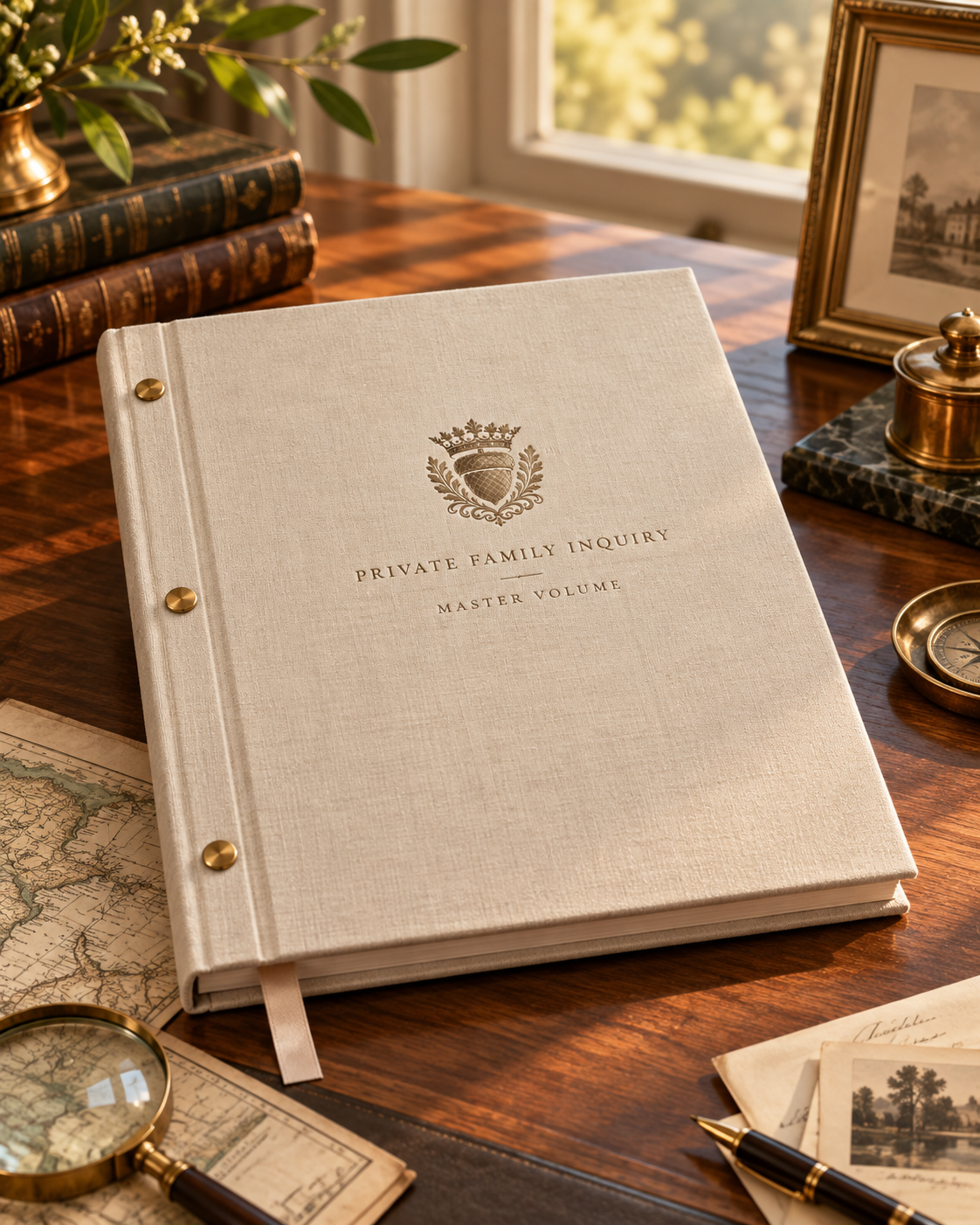
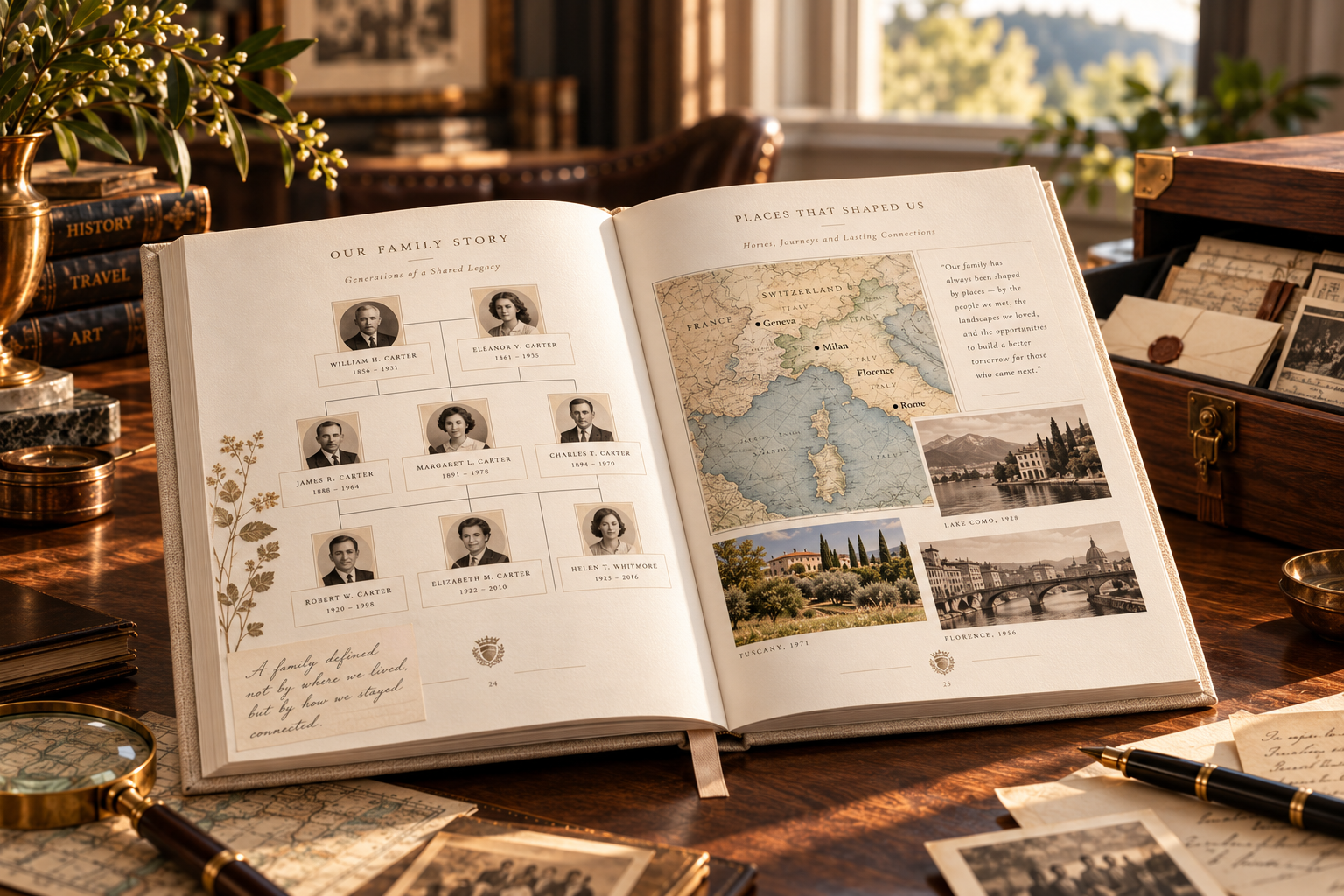

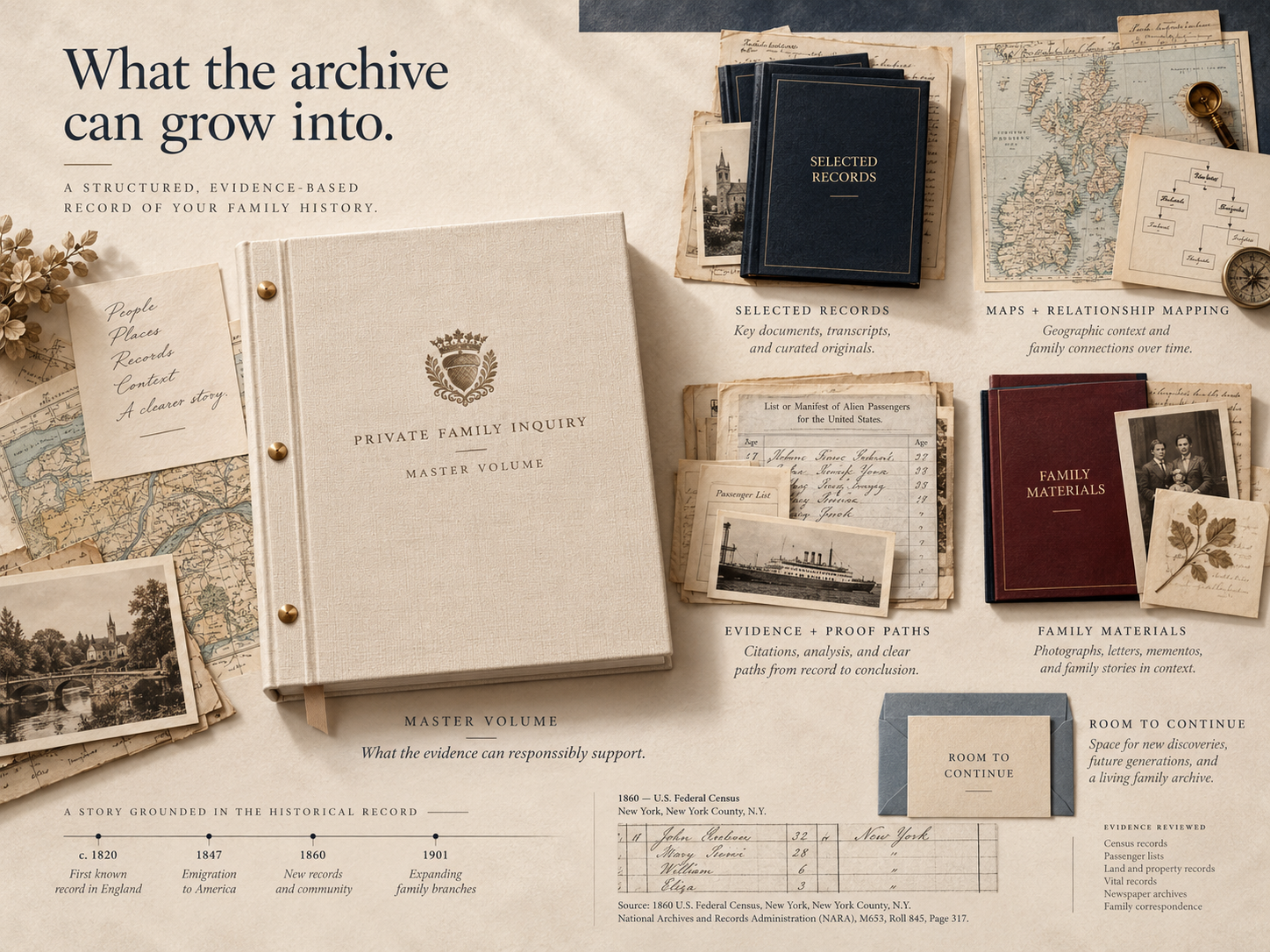
For many families, the Master Volume is the complete commission. When the history, materials, or future use call for more, the archive can expand without lowering the evidentiary standard that shaped the work.
Selected records, maps, facsimiles, transcriptions, evidence notes, and significant materials organized so the basis of the history remains visible.
A private, source-linked digital layer designed to receive future documents, photographs, voices, corrections, relationships, and discoveries without lowering the evidentiary standard.
Depth is not measured only in generations. A line that closes early may require more rigor, context, relationship mapping, or archival work than one that travels centuries. The commitment is a substantial, coherent record, not an arbitrary number of names.
No single record, institution, discipline, or lineage explains the whole relationship. The work is in understanding how the pieces fit together without flattening what makes each one distinct. That requires judgment about evidence, context, uncertainty, and discretion, not simply more research.
Testing claims, resolving contradictions, and preserving uncertainty where it remains.
Understanding how people, families, institutions, places, and inherited stories fit together.
Restoring context without inventing motives or flattening complexity.
Handling sensitive identities, family dynamics, public profiles, and consequential discoveries with care.
Translating a rigorous record into something understandable, durable, and worth keeping.
My work has repeatedly required the same combination this kind of inquiry demands: accuracy, context, discretion, and presentation. That includes family-authorized legacy material connected to Audrey Hepburn, work involving the Jacqueline Kennedy collection, public-facing historical projects involving figures such as Abraham Lincoln, and lineage questions connected to the DAR and the National Society of The Colonial Dames of America.
The contexts differ. The obligation is the same: understand the record, preserve its limits, and present it without flattening what makes it consequential.
Genealogy may extend a tree. Personal history may record a life. Bookmaking may create an heirloom.
The Inherited Map™ integrates evidence testing, relationship mapping, historical context, sensitive judgment, narrative structure, and archival form into one governed record.
Sensitive or consequential findings do not automatically become part of a family-facing record. Nothing consequential is made permanent by default. You see it first.
Understanding the record does not obligate you to act on all of it. Clarity means knowing you get to decide what is yours to carry, what deserves further attention, and what can responsibly be left alone.
You may arrive with a precise question, a family archive, a surname, an adoption story, a half-built tree, or simply the sense that something important has not yet been made clear.
Some private inquiries begin with a Clarity Case Review™. Others can be scoped directly when the existing material and desired outcome are already sufficiently clear.