The Morris Sisters:
Recovering a Female Relationship
from a Collapsed Lineage
A Historical Clarity Case Review™ showing how one Revolutionary War pension file preserved a sister relationship, challenged a copied-tree error, restored a Baptist recognition network, and opened a deeper research horizon without claiming more than the evidence can support.


How one pension file corrected a copied-tree error, restored a sister relationship, and opened a deeper legal-historical research horizon.
The Morris Sisters case demonstrates the value of evidence-led historical relationship mapping. The breakthrough was not simply finding a record. It was recognizing that the record preserved a female relationship the inherited tree structure had failed to protect.
The Morris case was not lacking names. It was a case of excess of names and fractured structure.
Across South Carolina, North Carolina, Virginia, and Tennessee records, Morris families appear with repeated given names, overlapping migration routes, shifting county boundaries, and confusing place references. Greenville District, South Carolina, and Greene County / Greeneville, Tennessee, have been especially vulnerable to conflation.
Later trees tried to solve the problem by attaching Phebe to a familiar Morris man.
But the timeline created a problem.
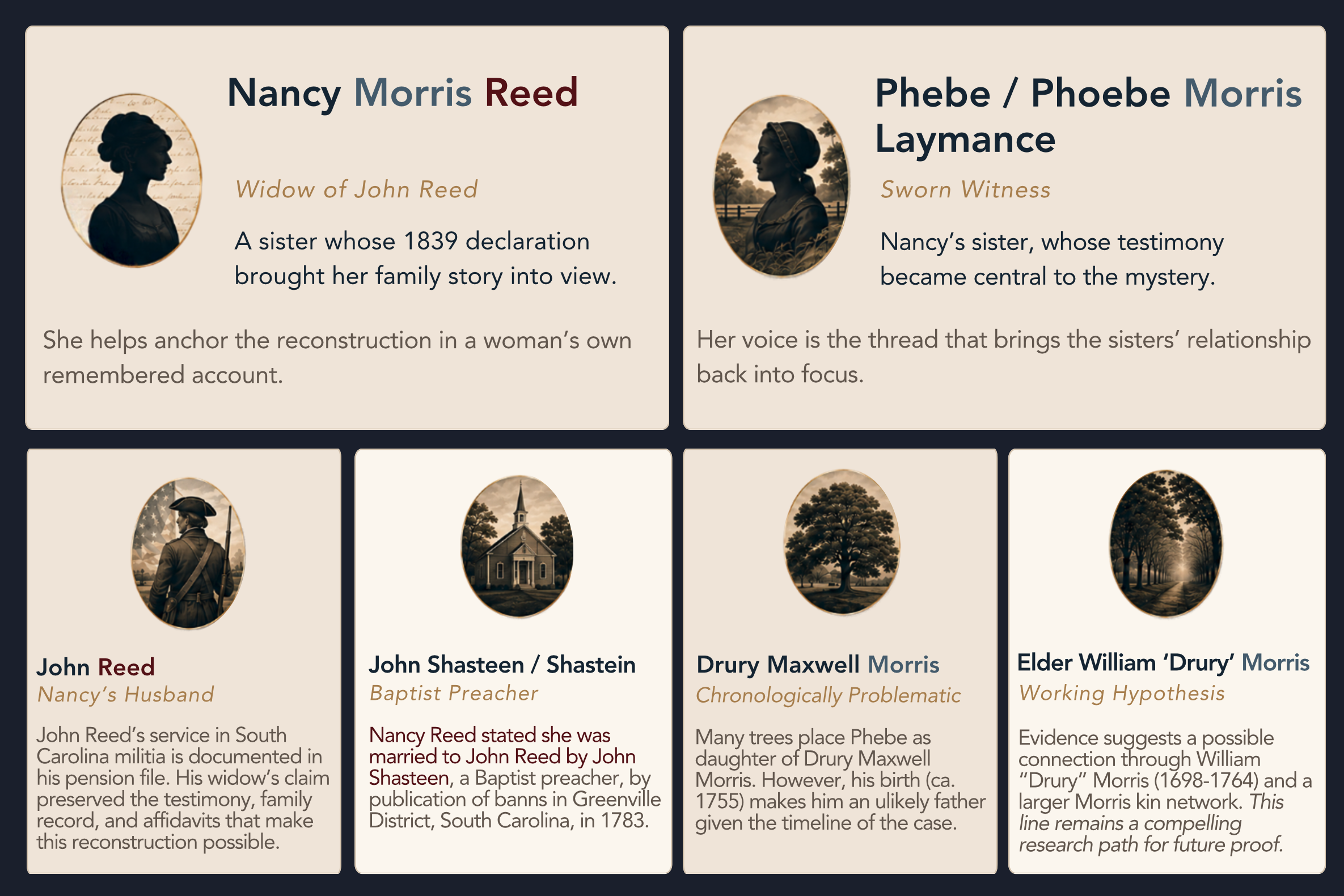
Nancy Morris Reed was born about 1763. Drury Maxwell Morris was born about 1755. He was only about eight years older than Nancy and could not plausibly have been her father.
If Nancy and Phebe were sisters, then Phebe also could not be responsibly placed in Drury Maxwell’s child generation without stronger evidence.
The question was no longer simply:
Who were Phoebe’s parents?
The better question became:
What generation did the record actually place her in, and which recognition systems preserved her identity?
The Evidence Ladder
What the record proves, what it challenges, and what remains open.
Established by Record
Nancy Reed’s maiden name was Morris. Phebe Laymance identified Nancy as her sister. The Reed–Morris marriage was remembered in Greenville District, South Carolina.
Strongly Challenged
The copied-tree placement of Phebe as a daughter of Drury Maxwell Morris and Rachel Hampton is chronologically implausible and not supported by the pension-file evidence.
Contextually Significant
The Baptist preacher, publication of banns, remembered house, pension system, migration route, and sister testimony form a recognition network.
Open Research Horizon
The possible Native maternal-line context, older Morris / Hammond / Veney field, enslaver-household networks, burial presentation, and exact parental mechanism require further testing.
Not Yet Proven
W193 does not prove the exact parents of Nancy or Phebe. It does not prove the Hammond / Veney bridge or any Indigenous identity claim.
The problem was not missing names. It was false structure.
For years, Phebe / Phoebe Morris Laymance appeared in some online trees and secondary compilations as a daughter of Drury Maxwell Morris and Rachel Hampton.
But the records suggested a different structure.
A Revolutionary War widow’s pension file preserved one crucial relationship: Phebe Laymance identified Nancy Morris Reed as her sister. That single word required the family line to be reconsidered.
The value of the Morris Sisters case is not simply that one relationship was corrected. The value is what that correction made possible.
This is evidence-led lineage reconstruction under historical pressure.
The Three Problems
This case separates.
Generational compression
Nancy and Phebe were sometimes placed into the wrong Morris generation.
Female-line visibility
Nancy and Phebe were not preserved through clean birth records, direct parentage statements, or a simple will.
Framework Error
The research question had been narrowed to 'Who was the father?'
The problem was not missing data. It was the wrong frame.
The central problem was not simply a missing parent. It wasa recognition problem: two women survived in the record through pensiontestimony, Baptist marriage memory, migration, and sisterhood, while latertrees tried to solve their identity through ordinary surname logic.
The work did not simply add records to a tree. It restored the structure of the question.
The Hinge Record
The Revolutionary War pension and bounty-land warrant file of John Reed / Nancy Morris Reed
On June 1, 1839 in Morgan County, Tennessee, widow Nancy Reed declared:
—
Nancy Reed's maiden name was Morris
—
she married John Reed in South Carolina in September 1783
—
the marriage was performed by John Shasteen / Shastein, a Baptist preacher
—
the marriage was by publication of banns
—
she had no written or documentary evidence of the marriage
—
she believed the marriage could be proved by Phebe Laymance of Morgan County, Tennessee
-6.png)
John Reed / Nancy Reed Revolutionary War pension and bounty-land warrant application file, W193.
This 97-page pension packet preserves the widow’s claim of Nancy Reed of Tennessee for the Revolutionary War service of John Reed, including the affidavit of Phebe Laymance, whose testimony is central to the Morris Sisters reconstruction. The file appears in the U.S. Revolutionary War Pension and Bounty-Land Warrant Application Files, 1800–1900, NARA microfilm publication M804, roll 2016.*
Two days later, Phebe Laymance testified that she remembered the marriage of John Reed and Nancy Reed at John Shasteen’s house in Greenville County, South Carolina. The transcript preserves the crucial sister language.
Together, the two statements form the proof chain:
Nancy identifies herself as Nancy Morris and names Phebe as the witness.
Phebe also confirms the marriage and identifies Nancy as her sister.
This is the hinge.
Not a copied tree.
Not inherited assumption.
This is a relationship preserved under oath because a widow had to prove a marriage the paper record had not preserved.

The two-statement proof chain
The sibling evidence does not rest on one sentence alone.
It emerges from two connected statements inside the same pension file.
— Nancy names herself.
— Nancy names Phebe.
— Phebe confirms the marriage.
— Phebe identifies Nancy as her sister.
This is not a loose association. It is a relationship built through adjacent sworn statements inside a pension-file proof system.

Nancy Reed stated that her maiden name was Nancy Morris. She said she had no written proof of her marriage to John Reed, but believed the marriage could be proved by Phebe Laymuns / Laymance of Morgan County, Tennessee.

Two days later, Phebe Laymance testified that she remembered the marriage of John Reed and Nancy Reed at the house of John Shasteen in Greenville County, South Carolina. The transcript preserves the crucial sister language.
One Kinship Word
Changed the Map
The turning point was not a surname. It was "sister".
Phebe did not appear as Nancy’s daughter.
— Not her niece.
— Not a neighbor.
— Not merely a family friend.
She appeared as the woman who remembered her sister’s marriage.
That word changed the structure of the family.
It moved Nancy Morris Reed and Phebe / Phoebe Morris Laymance out of the child generation of Drury Maxwell Morris and into an older Morris generational layer connected to Greenville District, South Carolina, before their later Tennessee associations.
This correction did not solve every parentage question.
It restored the right question.
The W193 pension file becomes a significant recognition record.
W193 is not merely a pension file.
It is a recognition file: a government packet in which military service, marriage, maiden name, child chronology, sister testimony, and administrative review were forced into one documentary field.
That matters because the record did not simply preserve names.
W193 preserved the systems that recognized people when ordinary records failed.
— Nancy had to prove marriage.
— Phebe had to preserve sisterhood.
— Children’s birth dates had to support continuity.
— A Baptist preacher’s role had to stand in for a missing civil record.
Later descendants must now reconstruct kinship from the systems that made these women visible only under pressure.
Read linearly, W193 is a pension claim.
Read relationally, it is a map of recognition.
Evidence Boundaries
What is supported by current evidence
The Nancy Reed’s maiden name was Morris.
Supported by her widow’s pension declaration.
Phebe Laymance and Nancy Morris Reed were sisters.
Supported by Phebe’s testimony as preserved in W193.
The Reed–Morris marriage occurred in Greenville District, South Carolina.
Supported by the pension materials naming John Shasteen / Shastein as Baptist officiant and placing the marriage at his house.
Phebe and Nancy belonged to an older Morris generation than the Drury Maxwell child placement suggests.
Strongly supported by the combined timeline and kinship evidence.
What is challenged by the evidence
Phebe as daughter of Drury Maxwell Morris and Rachel Hampton.
Chronologically implausible and not supported by the pension evidence.
Nancy’s age, Drury Maxwell’s approximate birth year, and Phebe’s identification of Nancy as her sister place both women in the same older generational layer.
What is now opened and under investigation
The elder William “Drury” Morris / Sarah Hammond Veney connection.
A high-value working hypothesis requiring probate, land, court, tax, church, and DNA-cluster corroboration. The male line may have been separated correctly.
The migration, movement and activity of an influential Morris Family
The place-name problem itself and migration through South Carolina / North Carolina / Tennessee is part of the record environment. The relationship field may be more connected than the male line alone can show.
The exact parental mechanism.
Full sister, half sister, shared maternal line, shared paternal line, household kinship, or another kinship structure remains to be tested.
Specific tribal identiy, mixed-heritage / Native context.
An important research lead requiring careful corroboration and contextual restraint.
Legal or racial dynamics affecting later recognition.
A historically plausible research question, not yet a final conclusion.
The families may be separate as direct male-line Y-DNA groups and still be connected as a historical relationship field.
These women may preserve a relationship network that the male-line framework including Y-DNA testing could not see.
The place-name problem itself and migration through South Carolina / North Carolina / Tennessee is part of the record environment.
The exact parental mechanism.
Full sister, half sister, shared maternal line, shared paternal line, household kinship, or another kinship structure remains to be tested.
The strength of this case is not that every question has been collapsed into certainty.
The strength is that the evidence has been ranked.
Why the Banns and Baptist Officiant Matter
The phrase “publication of banns”
is not a minor detail.
It tells us Nancy’s marriage may have been recognized through a public religious-community process even where a surviving civil marriage record has not been found.
Nancy did not simply say she had no written proof. She named the system that had recognized the marriage: a Baptist preacher, publication of banns, and community memory.
That changes the interpretation.
Her marriage should not be treated casually as “unrecorded.” It was recognized through a frontier religious and community system whose paper trail may not have survived.
That matters because it tells the researcher where to look next:
—
Baptist church minutes
—
association records
—
membership rolls
—
letters of dismissal and reception
—
ministerial records
—
local Baptist histories
—
neighborhood land and tax clusters
The case demonstrates one of the core principles of The Inherited Map™:
When ordinary vital records fail, search the systems that recognized the person.
The officiant network and a consequential relationship field.
John Shasteen / Shastein, the Baptist preacher named in W193, is likely connected to the regional Chastain / Chasteen Baptist network of the South Carolina backcountry.
This identification should remain probable, not final, pending direct church-level confirmation. But it is a serious research node because it places the Reed–Morris marriage inside a recognizable Baptist community structure rather than a vague frontier setting.
That network matters.
A preacher, a house, publication of banns, and a sister’s memory did more than preserve a wedding.
They preserved a relationship field.
The Method
Reading recognition systems goes beyond surnames
A traditional lineage search often moves in a straight line. That approach can fail when women are preserved indirectly, when civil records are missing, when marriages were recognized through church systems, when migration crossed county lines, and when identity was shaped by law, race, status, or household structure.
The Morris Sisters Case required a lateral method.
Instead of asking only, “Who was Phoebe’s father?” the reconstruction asked:
—
Who recognized Nancy’s marriage when no written marriage record survived?
—
Who remembered the marriage?
—
Why was Phebe the witness Nancy named?
—
What did the word “sister” do to the timeline?
—
Which generation did the evidence actually support?
—
Which Baptist, pension, migration, land, and legal systems made these women visible?
—
What larger research field becomes testable once the generational placement is corrected?
This is the difference between linear genealogy and historical relationship mapping.
The work did not move from one name to the next.
It moved across recognition systems: pension office, Baptist preacher, banns marriage, sister testimony, child-age record, migration corridor, estate language, and legal-history context.
This case also shows why no single tool should control the whole story. Male-line DNA may separate paternal lines, but women’s testimony and recognition records may reveal the wider relationship field that those lines moved through.
The work did not simply add records to a tree. It restored the structure of the question.
Why correct placement matters
Correcting Nancy and Phebe’s placement is not merely a family-tree adjustment.
It changes the historical question.
If the sisters are wrongly placed as children of Drury Maxwell Morris and Rachel Hampton, the inquiry collapses into the wrong generation.
If they are restored to the older Morris generation, the evidence can be tested against a different and potentially more significant field:
—
the elder William “Drury” Morris networ
—
Hammond and Veney-associated families
—
Baptist backcountry communities
—
South Carolina-to-Tennessee migration
—
maternal-line status
—
freedom-suit context
—
legal recognition of identity under pressure.
This is why the case matters.
Correcting their placement does not simply move two names on a tree. It changes which legal, kinship, religious, racial, and migration networks the evidence can responsibly be tested against.

The overlooked service-tour context

W193 contains another piece of context that should not be ignored.
Earlier in the same file, John Reed described an October 1783 tour after the reported September 1783 marriage. He described movement through upper South Carolina, crossing the Savannah River, moving toward waters of the Tennessee or Coosa, reaching a town called Chota, and participating in a violent frontier campaign involving Native people, prisoners, forced movement, and a Hammond / Hammons-associated authority figure.
This does not prove that Nancy or Phebe were daughters of Sarah Hammond Veney.
It does not prove a Hammond bridge.
But it changes the atmosphere of the file.
The same packet that preserves the Morris sister relationship also preserves a world of Revolutionary-era frontier violence, Native country, prisoner movement, South Carolina militia service, Baptist marriage recognition, and later Tennessee migration.
That is why this case deserves historical testing, not casual tree correction.
Do not collapse the two Drury questions
The copied-tree placement being challenged is Phebe as a child of Drury Maxwell Morris and Rachel Hampton. That placement is chronologically implausible and unsupported by W193.
The older William “Drury” Morris / Sarah Hammond Veney connection is a separate research horizon. It may matter, but it is not proven by W193.
The value of the case is that correct placement makes the older research field testable without turning it into a premature conclusion.
The Hammod / Veney Research Horizon
The Morris Sisters case may prove larger than a parentage correction — but only if future evidence can support the bridge.
W193 does not, by itself, prove that Nancy Morris Reed or Phebe / Phoebe Morris Laymance were daughters of Sarah Hammond Veney, William “Drury” Morris, John Morris, or any other proposed parent. Its importance is more precise.
W193 establishes a documented Morris sister pair in the right generational layer, connected to Greenville District, South Carolina, and later Tennessee. That correction opens the older Morris / Hammond / Veney research field on stronger terms.
If future evidence securely connects Nancy and Phebe to the Hammond / Veney family, the case would extend beyond ordinary lineage correction into the legal history of Native maternal descent, racial classification, freedom suits, and frontier recognition.
Download the Morris Sisters Evidence Brief
A deeper look at the record, proof boundary, research horizon, and method behind this Historical Clarity Case Review™.
The web page presents the executive case. The Evidence Brief preserves the deeper record: the proof chain, evidence ladder, timeline, research boundary, Baptist recognition network, and next-stage questions.
The Frontier Recognition System
This case is best understood as a relationaship and recognition problem.
History reminds us that women’s identity and status often had to be proved under pressure:
Nancy had to prove marriage.
Phebe had to preserve sisterhood.
Children’s birth dates had to support continuity.
A Baptist preacher’s role had to stand in for a missing civil record.
Later descendants must now reconstruct kinship from the systems that recognized people only when recognition became necessary.
The records that matter are not all the same kind of records.
Historic value: Why this case matters beyond the family tree.
The Morris Sisters Case matters because it sits at the intersection of several larger histories. It touches Revolutionary War pension practice because Nancy’s widow claim forced military service, marriage proof, family identity, and witness testimony into one administrative file.
It touches Baptist religious history because the marriage was remembered through a preacher, a house, and publication of banns rather than through a surviving civil license.
It touches women’s archival history because Nancy and Phebe survive through claim, witness, memory, and oath rather than through direct birth records.
It touches migration history because the record places a South Carolina marriage network and later Tennessee testimony inside a broader backcountry-to-frontier movement.
It touches Native and legal-history research because a potential Hammond / Veney connection, if proved, would bring the case into conversation with freedom suits, Native maternal descent, racial classification, and the legal struggle to prove identity under pressure.
The case should not be overstated.
Its power comes from the opposite discipline: it shows how much can be responsibly opened when one relationship is correctly placed.

Women often survive in the archive through other people’s paperwork
Phebe and Nancy were not preserved as the central figures of a family history. They had to be recovered from the edges. Yet one affidavit preserved something intimate and structurally important.
This is the human story survived through:
—
a husband’s pension
—
a preacher’s name
—
a widow’s claim
—
a sister’s testimony
—
a marriage remembered decades later
Phebe remembered:
—
her sister’s marriage
—
the place
—
the preacher
—
enough to testify
—
That memory became evidence.
The hidden value is in showing how belonging had to be proven.
The Morris Sister's Case is not merely a correction of two women in the wrong generation; it is a rare recoverable example of how female identity survived a legally unstable frontier through Baptist witness networks, pension testimony, freedom-suit logic, migration corridors, and the same maternal-line evidence that Native-descended families used to reclaim freedom.
This reconstruction of the Morris Sisters demonstrates why evidence-led historical relationship mapping works:
—
identify what others copied but did not test
—
restore women’s identities under documentary constraint
—
separate repeated names across generations and regions
—
distinguish proof from context
—
challenge inherited assumptions without overclaiming
—
preserve uncertainty honestly
—
interpret sensitive historical context with dignity
—
translate scattered records into coherent legacy intelligence
This is not ordinary genealogy.
Fragmented historical inheritance becomes clarified without being flattened
A repeated copied-tree error became an opportunity to restore generational coherence, protect two women from misplacement, recover a Baptist recognition network, and create a disciplined path for future proof.
The outcome is not simply a decorative family story.
It is a usable legacy asset:
—
clearer evidence structure
—
corrected generational placement
—
protected research boundary
—
stronger institutional conversation
—
more responsible foundation for descendants and future stewards
The goal is not to make the story more dramatic. The goal is to make it more true.
We did not just correct a name.

We restored the evidence field around two women whose identities survived because one sister remembered another.
Not Sure What
is True?
Begin with a confidential
Historical Clarity Case Review™.
The Inherited Map™ helps families, founders, estates, archives, and institutions turn historical fragments into documented legacy assets that support stewardship, continuity, and decision-making.
If you are carrying an inherited claim, a confusing family line, a possible lineage error, or a historically significant story that needs disciplined review, begin with a confidential conversation.
Begin with a confidential conversation.
Serious inquiries are personally reviewed by Amy Rookstool and are usually answered within 48–72 hours, depending on complexity.