I
The long-held assumption
The working story kept pulling toward a parentage claim the record had not proved. Repeating the same frame produced more material, but not more certainty.

I look for the place where the evidence stops fitting the inherited story. That friction often reveals the assumption distorting the question, or the relationship the existing framework has made difficult to see.
The work moves from evidence to context, from context to discernment, and from discernment to a conclusion proportionate to what the record can actually support. The aim is not more certainty than the evidence allows. It is a clearer basis for disciplined discernment.
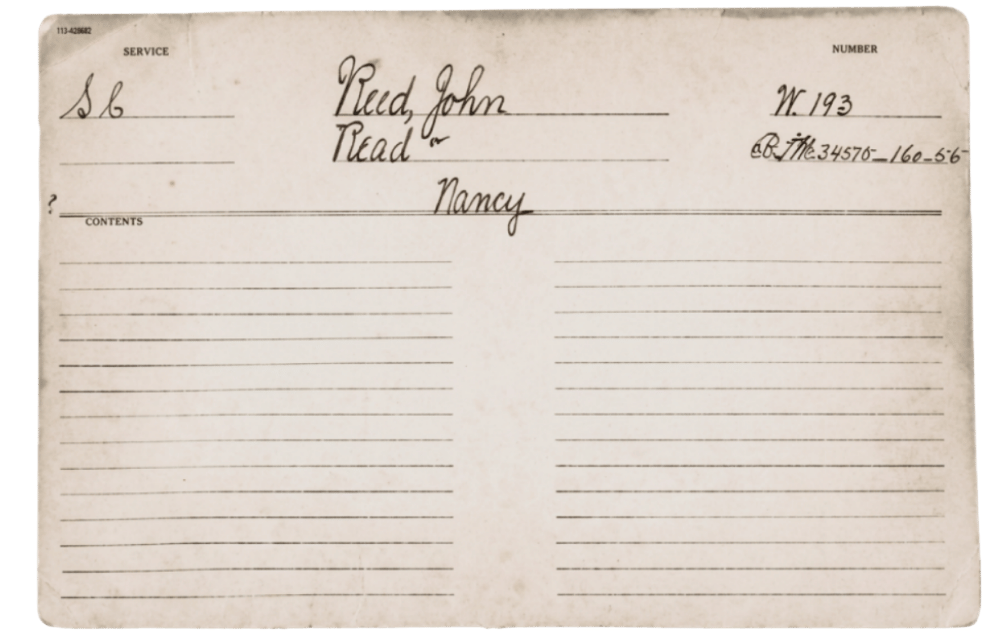
Read the Morris Sisters caseA long-stalled lineage question changed inside the Revolutionary War pension and bounty-land file of John Reed. The file was created to document military service and a widow’s claim. Read laterally, it also preserved a marriage, a maiden name, and the testimony that reconnected two sisters.
The working story kept pulling toward a parentage claim the record had not proved. Repeating the same frame produced more material, but not more certainty.
The John Reed / Nancy Reed Revolutionary War pension and bounty-land application file, W-193, preserves the affidavit of Phebe Laymance, who identified Nancy Morris Reed as her sister.
The file did not need to prove their parents to change the case. The sister relationship was strong enough to change the map of the problem.
Once the sisters were placed together, Baptist marriage recognition, South Carolina-to-Tennessee migration, chronology, and the wider Morris / Hammond / Veney research field could be examined without forcing a parentage conclusion.
On June 1, 1839, in Morgan County, Tennessee, widow Nancy Reed declared that her maiden name was Morris, that she had married John Reed in South Carolina in September 1783, and that the marriage could be proved by Phebe Laymance.
Two days later, Phebe testified. She remembered the marriage, named the place and the Baptist preacher, and identified Nancy as her sister.
That single relationship changed the structure of the case.
Historical Relationship Mapping™ traces how people, records, places, institutions, events, and inherited narratives relate across time. No single record, institution, discipline, or lineage explains the whole relationship. The work is understanding how the pieces fit together without flattening what makes each one distinct.
Context-preserving integration brings those pieces together without flattening the distinctions that give them meaning: chronology, jurisdiction, religious practice, migration, legal status, institutional language, memory, and uncertainty.
What does this source actually establish, and what is being inferred?
What kind of relationship did the surviving evidence show existed?
What legal, social, cultural, geographic, or institutional system shaped the record?
How was the relationship transmitted, transformed, interrupted, or later remembered?
The visible method: tracing how people, records, places, institutions, events, and inherited narratives relate across time.
The governing discipline: bringing those elements together without flattening chronology, uncertainty, historical conditions, or the questions people were actually living with.
Together, they make it possible to see more without claiming more than the evidence can bear.
I do not begin by deciding what the story should be. I look for what does not fit: the woman who disappears behind a married name, the place that changes jurisdiction, the record that conflicts with a later tradition, the institution whose terminology hides a relationship, or the elegant lineage that asks the evidence to carry more weight than it can.
Friction shows where the assumptions are. It also shows where a better question, a missed relationship, or the next useful source may be hiding.

Historical Relationship Mapping™ and context-preserving integration are useful only when proof boundaries remain explicit. Source criticism, chronology, negative evidence, and historical context keep the interpretation proportionate to what the record can actually support.
Supported, plausible, unresolved, and disproved are not interchangeable.
An honest open question can be more valuable than a premature conclusion.
Sometimes the breakthrough is not a new record. It is a better question.
Member, National Genealogical Society.
Context-preserving integration brings evidence together without erasing the distinctions that give it meaning. Names and dates matter, but so do the questions people were trying to solve, what they could not yet know, and the systems in which their choices were made.
That discipline allows family evidence, archives, public memory, place, institutions, and historical systems to inform one another without becoming one undifferentiated story.
When the history carries consequence, the right next step depends on the question: a focused Clarity Case Review™, a deeper private commission, or an institutional inquiry requiring responsible interpretation.
See the Clarity Case Review™